Revolt And The Dreamcast

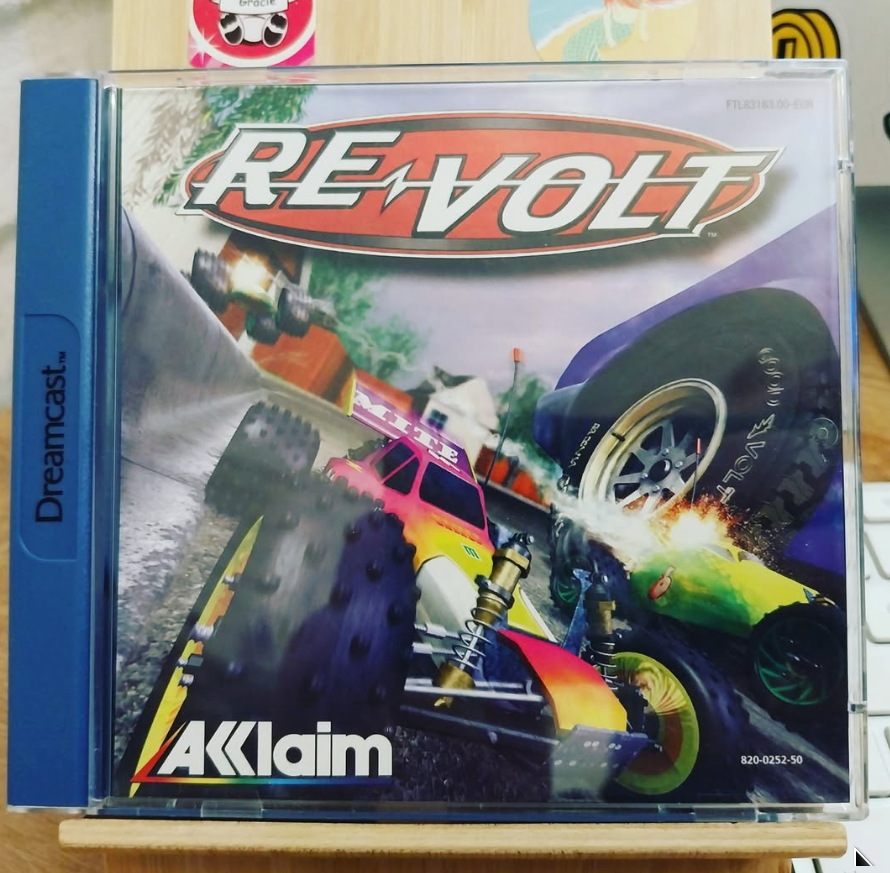
Re-Volt And the Dreamcast: Tiny Cars, Huge Memories, Great Console
There are some games you remember because they were technically impressive, some because they were brilliantly designed, and others simply because of who you played them with. Re-Volt on the Sega Dreamcast manages to tick all three boxes for me. Released at the end of the 1990s, it took the simple idea of radio controlled car racing and turned it into something far more memorable. Instead of driving full sized cars around conventional circuits, you controlled tiny RC cars through oversized everyday environments. Suburban streets, museums, supermarkets and industrial areas suddenly became enormous playgrounds when viewed from only a few centimetres above the ground.
For me, though, Re-Volt is tied just as closely to memories of playing it with my brother. We spent countless hours racing each other, learning the tracks, discovering shortcuts, crashing into scenery and generally doing whatever we could to make the other person lose. He went out and bought a Dreamcast as he said it looked good in the adverts, and he wasn't wrong. He bought a collection of games with his first pay check and one of those games was Re-Volt. Like so many multiplayer games from that era, much of the entertainment came from what was happening away from the television as much as what was happening on it. There were arguments, rematches, complaints about unfair weapons, accusations of cheating and the inevitable insistence that the previous race somehow did not count. Those are the gaming memories that tend to stick with you.
Perhaps Re-Volt worked so well for us because radio controlled cars were already something we loved. Like many kids, my brother and I were fascinated by them. There was something magical about being able to control a miniature vehicle from a distance, particularly at an age when driving a real car was still impossibly far away. That enthusiasm has never really disappeared either. Even now, I still love radio controlled cars. It does not matter whether it is a cheap toy, a high speed modern machine or something carefully built and modified. Put a controller in my hand and I will probably want a go. I actually have 25 radio controlled cars in this house, but that's another story for another day!
That fascination inevitably carried over into videogames. Another favourite of mine was Smash Cars, which appeared on the PlayStation 2 and later in a different form on the PlayStation 3. It had the same basic appeal and I still play it! Small radio controlled cars, exaggerated environments, jumps, obstacles and that wonderful feeling that the entire world has suddenly become a racetrack. RC car games occupy a strange little corner of gaming that I wish developers would revisit more often. We have endless realistic racing games, enormous open world driving games and painstaking simulations, but there is something uniquely entertaining about racing a tiny car through an environment that was never designed for it. The jumps, flips, tricks and stunts you can do with the cars give it an extra dimension, you can't do that in Gran Turismo.
How Re-Volt Plays
At its heart, Re-Volt is an arcade racing game, but the radio controlled cars give it a very different feel from conventional racers. The cars are light, twitchy and extremely responsive, which means even small bumps, kerbs and changes in surface can send you off line. Learning how each car behaves is part of the fun, because some are fast but difficult to control while others are slower and more forgiving.
The tracks are built around oversized everyday environments, and that scale completely changes how the racing feels. A pavement edge becomes a serious obstacle, a table leg becomes something to dodge, and a small ramp can launch the car across half the room. There are shortcuts hidden throughout many of the circuits, and finding the quickest route can be just as important as having the fastest car.
Weapons and power ups add another layer of chaos. You can pick up items during the race and use them to slow down opponents, protect yourself or cause complete mayhem at exactly the wrong moment for everyone else. It means races are rarely predictable, and even a comfortable lead can disappear in seconds.
The handling has a slightly loose, playful feel that suits the subject perfectly. Cars can bounce, spin, flip and recover in ways that would be ridiculous in a realistic driving game but feel completely right here. The result is a game that rewards skill without ever becoming too serious.
What really makes Re-Volt work is the combination of speed, unpredictability and track design. You are constantly balancing precision with aggression, trying to take the fastest line while also reacting to weapons, jumps, obstacles and other cars. It is simple to pick up, difficult to master, and exactly the kind of game that becomes even better when played against someone sitting next to you.
But most of all, for me, its a pick up and play game. It doesn't feel like a second job like some modern games are, I don't have time for that in my life. Maybe that's why I like retro games, they're all pick up and play when you think about it.
The Dreamcast Difference
Part of my affection for Re-Volt comes from the machine I played it on. The Sega Dreamcast remains one of my favourite consoles, and I still think it was massively undervalued during its lifetime. It appeared at a fascinating point in videogame history, when the industry was moving away from the blocky early 3D graphics of the original PlayStation and Nintendo 64 era and towards the cleaner, faster worlds that would define the early 2000s. The Dreamcast was slick, it felt like a jump in performance rather than an incremental improvement like so many consoles these days.
When the Dreamcast appeared, it felt like an enormous leap forward. Games looked sharper, colours were vibrant, textures were cleaner and animation was noticeably smoother. Many games ran at frame rates that made earlier 3D consoles suddenly feel old fashioned. At the time, the Dreamcast genuinely felt like having an arcade machine in your house, and that was not entirely accidental. Sega had decades of arcade experience behind it, and the console was filled with games that captured that immediate arcade feeling brilliantly. And seriously, who doesn't love Sega? Even old school Nintendo fans of today will surely admit, Sega does have a place in their heart from 'back in the day' in the 80's and 90'.
Crazy Taxi, Soulcalibur, Virtua Tennis, Power Stone, Sega Rally 2 and Daytona USA 2001 all had that same quality. You turned the machine on, picked up the controller and started playing. There was a directness to it that feels refreshing when compared with modern gaming. There were no enormous installations, huge updates or endless menus to navigate before you could actually play. You simply put the disc in and got on with it.
Re-Volt fitted that world perfectly. Its colourful environments, detailed miniature cars and fast racing looked superb on the Dreamcast. The machine had enough power to make those environments feel convincing while still delivering the speed that an arcade style racer needed. Seeing a tiny car tearing through oversized locations was visually impressive at the time, and the smoothness of the Dreamcast made the whole experience feel even better.
A Console That Arrived Too Early
Looking back, the Dreamcast becomes even more impressive because of how many ideas it introduced before they became normal. It included a modem for online connectivity at a time when console internet gaming was still considered unusual. Sega experimented with online multiplayer, downloadable content and web browsing years before those features became expected.
Then there was the VMU, the little memory unit with its own screen that plugged into the controller. It was strange, inventive and wonderfully Sega. The Dreamcast was full of ideas like that. It felt as though Sega was trying to imagine where console gaming was going rather than simply copying what had come before.
Unfortunately, it also arrived at exactly the wrong time. Sony had enormous momentum from the original PlayStation, and the PlayStation 2 was looming on the horizon. The PS2 also offered DVD playback at a time when dedicated DVD players were still relatively expensive, which gave it a huge advantage as both a games console and a home entertainment system.
The Dreamcast simply could not compete with the level of anticipation surrounding Sony's new PS2 machine. By 2001, Sega announced that it was ending production of the Dreamcast and withdrawing from the console hardware business.
For me, it happened far too soon.
The Dreamcast felt as though it had barely begun showing what it could do when the plug was pulled. Developers normally become better at exploiting console hardware as the years pass, and it is fascinating to wonder what might have been achieved if studios had enjoyed another three or four years working with the system. The PlayStation 2 went on to become one of the most successful consoles ever created, and deservedly so, but I have always felt that the Dreamcast should have been allowed to exist alongside it for much longer.
From Commercial Disappointment to Collectable Classic
There is a certain irony to the Dreamcast story. The machine that struggled commercially when it was new has gradually become one of the most loved consoles among retro gaming enthusiasts. Hardware, accessories and games are now sought after by collectors, with complete boxed systems and rarer titles becoming increasingly valuable. That feels like a form of overdue recognition.
People now appreciate just how unusual the Dreamcast was. Part of that affection is obviously nostalgia, but there is more to it than that. The Dreamcast library remains genuinely distinctive. The machine has personality in a way that many consoles do not. You can look at a Dreamcast game today and immediately recognise the era it came from. Bright colours, clean 3D graphics, high frame rates and that unmistakable arcade influence run through much of the library.
Even the console itself still looks strangely futuristic. The white casing, orange swirl and compact design somehow manage to feel both extremely late 1990s and oddly timeless.
For collectors, that distinctive identity matters. The Dreamcast is no longer simply an old games console. It represents a particular moment in gaming history when Sega was still willing to take risks and try strange ideas. As fewer complete systems survive and desirable games become harder to find, its place as a collectable machine seems likely to become even stronger.
Bring Back Re-Volt
Of all the games from that era that deserve a proper return, Re-Volt is high on my list. The concept still works. In fact, with modern graphics and physics it could be spectacular.
Imagine a new Re-Volt that kept the same basic philosophy. Tiny RC cars racing through houses, garages, gardens, shopping centres, museums, warehouses and toy shops. Everyday objects would become enormous obstacles. A kitchen table could be a full racing environment. A garden could become an off road course. A multi storey car park could turn into a miniature endurance race.
Keep the speed. Keep the jumps. Keep the shortcuts and the chaos. Give us proper local multiplayer and online racing, but do not bury it under endless progression systems or unnecessary complexity. The attraction of Re-Volt was always its simplicity. Pick a car, choose a track and race.
Most importantly, keep it fun.
Not every game needs to be an enormous cinematic experience that takes eighty hours to finish. Sometimes you simply want to sit beside your brother, choose a radio controlled car and spend an evening trying to knock each other off the track.
That is what I remember when I think about Re-Volt. I remember the Dreamcast. I remember the RC cars we loved as kids and still enjoy now. I remember the speed, the colourful graphics and the feeling that Sega had somehow put a little arcade machine underneath the television.
More than twenty five years later, those memories are still there. That is probably the greatest compliment you can give any game.
Bring back Re-Volt.
